How Does Professional Excavation Improve Drainage and Structural Stability?
June 15, 2026
Water and soil may seem like passive forces, but left unmanaged, they become two of the most destructive elements a property can face. Poor drainage causes water to pool near foundations, saturate load-bearing soils, and erode the ground beneath structures over time. These are not cosmetic issues. They compromise the very integrity of what sits above ground, from driveways and retaining walls to homes, commercial buildings, and utility systems. Recognizing these risks early and addressing them with precision is what separates a well-maintained property from one in steady decline.
Professional excavation sits at the heart of drainage and structural stability work. It is not simply about moving dirt. It is about understanding soil behavior, water movement, grade relationships, and load distribution. When we approach an excavation project, every decision we make underground influences what happens above it for years to come. Proper grading, trench placement, drainage channel positioning, and foundation preparation all depend on excavation done with accuracy and experience. This blog breaks down how professional excavation directly improves drainage outcomes and protects structural stability across residential and commercial properties.
Understanding the Relationship Between Excavation, Drainage, and Soil Stability
How Soil Conditions Drive Everything
Before any excavation begins, understanding the soil profile is essential. Different soil types behave very differently when exposed to moisture. Clay soils expand when wet and contract when dry, creating pressure cycles that can crack foundations. Sandy soils drain quickly but offer poor structural support unless properly compacted. Loam and mixed soils present their own challenges depending on depth, composition, and proximity to groundwater.
Professional excavators conduct soil assessments before breaking ground. We identify load-bearing capacity, permeability rates, and any weak or unstable zones. This information directly shapes how we grade the site, where we route drainage, and how deep we excavate for foundations or utility installations.
The Grade Is Everything
One of the most impactful aspects of professional excavation is establishing correct site grade. Grade refers to the slope of the ground relative to structures on the property. When grading is done incorrectly, even by a small margin, water flows toward foundations instead of away from them.
We use precise grading techniques to direct surface water toward designated drainage zones, retention areas, or municipal systems. A properly graded site eliminates standing water, reduces soil saturation near structures, and prevents the kind of long-term erosion that slowly undermines footings and slabs.
Drainage Systems That Require Professional Excavation
French Drains and Subsurface Water Management
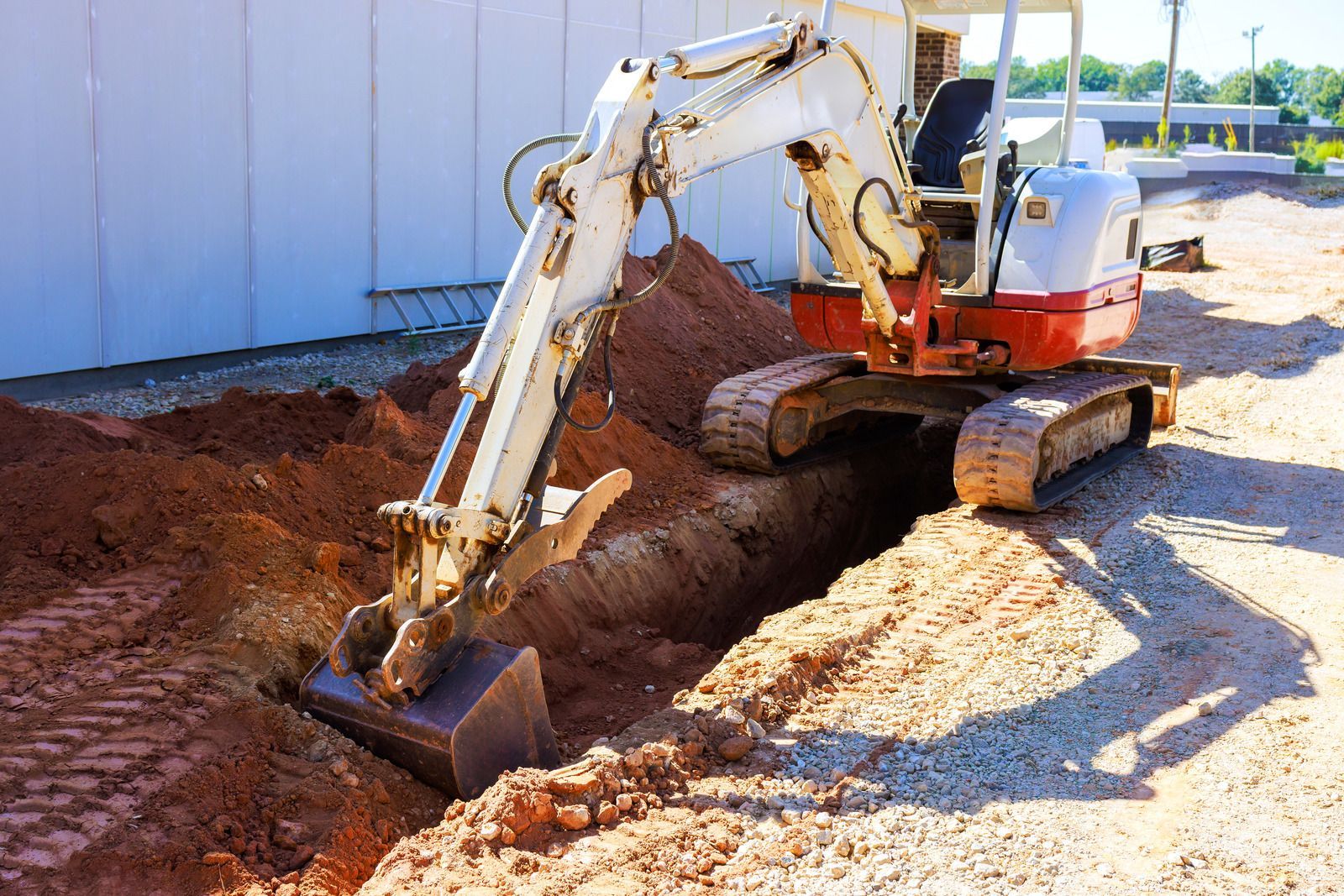
French drains are one of the most widely used solutions for managing subsurface water on residential and commercial properties. A French drain consists of a perforated pipe wrapped in filter fabric, installed in a gravel-filled trench that redirects groundwater away from problem areas. Installing one correctly requires precise excavation to the right depth, slope, and outlet location.
If the trench is too shallow, the drain will not intercept the water table. If the slope is miscalculated, water will pool inside the system rather than drain. We excavate French drain trenches with attention to both depth and gradient, making sure the entire system functions as a continuous flow path rather than a disconnected series of sections.
Channel Drains and Surface Water Interception
Channel drains, also called linear drains, are installed flush with paved or landscaped surfaces to intercept runoff before it reaches structures. They are common in driveways, parking areas, and around building perimeters. Proper installation requires excavating a precise channel of uniform depth, bedding it in concrete or compacted aggregate, and connecting it to a downstream outlet.
When surface water hits a structure repeatedly over time, it saturates the soil around the foundation. This leads to hydrostatic pressure, which is one of the leading causes of foundation wall cracking and basement water intrusion. A well-installed channel drain eliminates that cycle entirely.
| Drainage Method | Best Application | Key Excavation Requirement |
|---|---|---|
| French Drain | Subsurface water, wet yards | Depth and gradient accuracy |
| Channel Drain | Surface runoff, paved areas | Uniform trench and flush installation |
| Swales | Large properties, stormwater | Grade shaping and compaction |
| Retention Basin | High runoff volume | Volumetric excavation and outlet routing |
Swales and Retention Basins
On larger properties, swales and retention basins handle higher volumes of stormwater. A swale is a shallow, graded channel that guides water across a landscape in a controlled path. A retention basin temporarily holds water and releases it slowly to prevent downstream flooding.
Both require significant excavation work and careful grade planning. The shape, depth, and compaction of a swale or basin determine how well it holds water, prevents erosion along its edges, and transitions flow toward safe outlets. We design and excavate these features based on site-specific drainage calculations, not generic estimates.
Foundation Excavation and Structural Stability
Why Foundation Prep Determines Long-Term Performance
A structure is only as stable as the ground it sits on. Foundation excavation is not a step to rush. We excavate to a depth that reaches stable, undisturbed soil, ensuring the footing rests on ground that will not shift, compress, or wash away under load.
In areas with expansive clay soils, we often excavate deeper than the minimum code requirement and introduce compacted aggregate layers that buffer against the soil's movement. This extra preparation protects the structure from the differential settling that causes cracked walls, misaligned doors and windows, and long-term foundation damage.
Compaction and Backfill Practices
After excavation and foundation installation, the backfill process is equally critical. Poorly compacted backfill allows water to channel directly down alongside foundation walls, bypassing any drainage systems we have installed. It also creates voids that collapse under load over time.
We compact backfill in lifts, typically 6 to 8 inches at a time, using plate compactors or rammers depending on the material and space constraints. This eliminates voids, stabilizes the surrounding soil, and ensures that water sheds away from the structure rather than pooling against it.
Retaining Wall Excavation
Retaining walls serve a dual purpose: they hold back soil on sloped properties and manage water movement through or around that soil. When we excavate for a retaining wall, we account for the load of the retained soil, drainage pressure behind the wall, and footing depth.
A retaining wall without proper drainage behind it will eventually fail. Water builds up in the soil mass, adding weight and hydrostatic pressure that the wall was not designed to handle. We install drainage aggregate and perforated pipe behind retaining walls during excavation so that water can escape before pressure accumulates.
Common Drainage Problems That Professional Excavation Solves
Standing Water and Saturated Yards
Standing water after rain is a clear sign that the site grade directs flow toward low points with no outlet. It damages grass and landscaping, creates mosquito breeding grounds, and accelerates soil saturation near structures. We regrade affected areas and install subsurface drainage to route that water away from the property.
Foundation Settling and Cracking
If a foundation is settling unevenly, the cause is almost always soil-related. Either the original excavation was inadequate, the backfill was poorly compacted, or drainage was never addressed. We excavate around affected foundations to assess conditions, improve drainage, and stabilize the surrounding soil where possible.
Erosion on Sloped Properties
Sloped sites erode quickly when surface water has no controlled path to follow. We excavate and install swales, check dams, or channel systems that slow and redirect water, reducing the velocity that causes soil loss. Erosion control and drainage work go together, and excavation makes both possible.
Best Practices in Professional Excavation for Drainage Projects
Experienced excavators follow a set of practices that distinguish precise, lasting work from rushed, surface-level solutions.
Site assessment before excavation: We walk every site, evaluate existing drainage patterns, identify problem areas, and review soil conditions before any machine moves.
Accurate grade calculations: We use laser levels and grade stakes to verify slope throughout the excavation process, not just at the start.
Proper pipe sizing and placement: Drainage pipe diameter and perforation pattern depend on the volume of water the system needs to handle. Undersized pipe causes backups; oversized systems may not maintain the self-cleaning velocity needed to stay clear.
Filter fabric use: We wrap all perforated pipe in filter fabric before installation to prevent fine soil particles from migrating into and clogging the drainage system over time.
Outlet verification: Every drainage system needs a clearly defined outlet. We confirm that outlets are clear, properly protected from erosion, and capable of handling peak flow without backup.
Experienced Excavation Contractors Committed to Gainesville Property Integrity
Professional excavation is the foundation beneath every reliable drainage system and structurally sound property. From grading and French drain installation to foundation preparation and retaining wall drainage, every element depends on excavation done with accuracy and site-specific knowledge. The decisions made below ground determine how water moves, how soil behaves under load, and how structures hold up across seasons and years. Skipping this work or doing it without experience creates problems that compound quietly until they become expensive structural failures. When drainage and stability matter, the excavation work has to be right the first time.
Georgia Land Pros
is an excavating contractor based in Gainesville, Georgia, with 5
years of hands-on experience serving residential and commercial property owners across the region. We specialize in site preparation, drainage system installation, foundation excavation, land clearing, and grading work that addresses real drainage and structural challenges at their source. Whether you are dealing with standing water, foundation movement, a sloped property prone to erosion, or a new construction site that needs proper preparation, Georgia Land Pros
has the expertise to handle it. We are committed to doing the work right and standing behind every project we complete.
Frequently Asked Questions
1. What is the difference between surface drainage and subsurface drainage?
Surface drainage manages water that runs across the ground after rain by shaping grade and installing channels. Subsurface drainage intercepts water moving through soil using perforated pipes, gravel trenches, and similar systems installed below grade.
2. How deep does a French drain need to be installed?
Depth depends on the water source being intercepted. Most residential French drains are installed between 18 inches and 4 feet deep, with the pipe set at a gradient that allows gravity to move water toward the outlet without pooling.
3. Can poor drainage really damage a foundation?
Yes. Water that repeatedly saturates soil around a foundation creates hydrostatic pressure against foundation walls and causes the soil beneath footings to shift, compress, or erode. Over time, this leads to cracking, settling, and structural instability.
4. How do I know if my property needs professional excavation for drainage?
Common signs include standing water that lingers for hours or days after rain, soil erosion on sloped areas, wet or damp basement walls, doors and windows that stick or no longer close properly, and visible foundation cracks that were not present before.
5. Is grading the same as excavation?
Grading is a part of excavation work, not a separate process. Excavation involves removing and moving soil to achieve a desired depth or profile, while grading refers to the precise shaping of that soil to establish correct slope and drainage direction. Both are part of a complete site preparation approach.